NUMERICAL PARTITION ANALYSIS
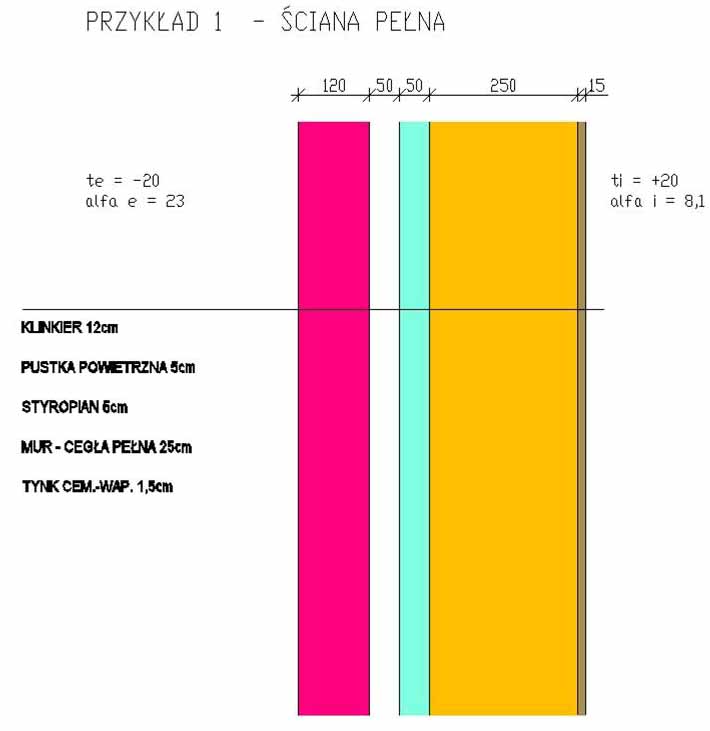
We define the Uo of the partition as in the picture.
They will perform here:
internal plaster, cement-lime. λ = 0,850 W / mK
ceramic brick wall λ = 0,800 W / mK
polystyrene λ = 0,045 W / mK
wall made of full clinker brick, moist λ = 1,150 W / mK
reinforced concrete λ = 1,800 W / mK
stal λ = 58,000 W / mK
parking λ = 0,250 W / mK
concrete concrete λ = 1,700 W / mK
glass λ = 0,800 W / mK
clay soil in accordance with PN-EN λ = 1,500 W / mK
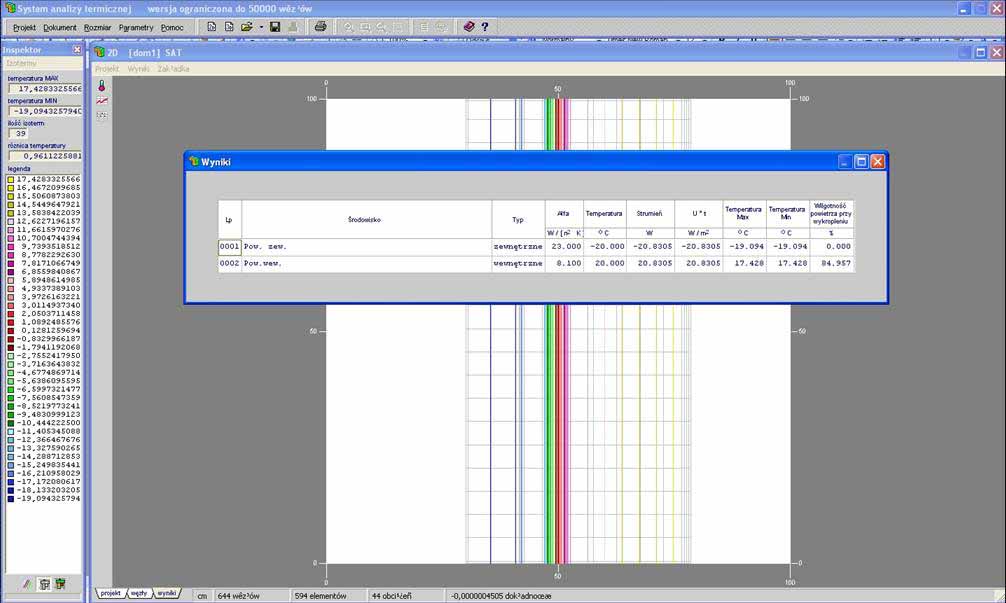
We calculate U0 assuming:
The external environment:
at (θe) = -20 st. C
ae = 23,0 W / m2K
Internal environment:
of (θi) = 20 st. C
ae = 8,1 W / m2K.
We do it "manually", i.e.. calculating the partition resistance by summing up the individual layer resistances and interceptions and then U0 = 1 / Rc
Or we do it numerically by getting the stream 20,8305 In falling on
1m2 i 40 st. C (40K) temperature difference.
U0=20,8305/1/40 =0,521 W/(m2K)
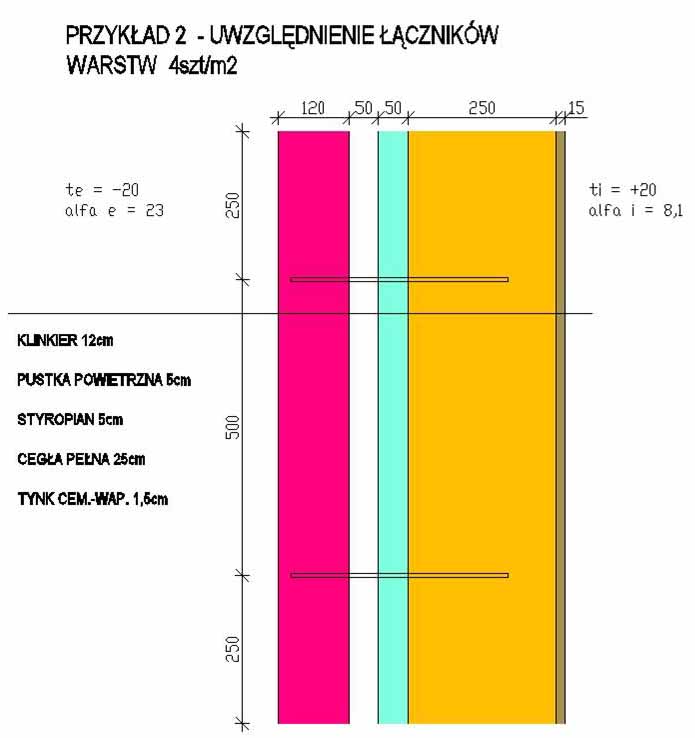
The traditional layered wall is connected with anchors. Each of them is a point bridge. It is impossible to determine its actual impact without numerical calculations or research (thermovision or laboratory). We perform numerical modeling. Model 3D. The cross-section of the anchor is replaced by a square with an equivalent cross-section (same surface area) cross section. Here it was introduced in the model 2 anchors. It could be single or 4 at once. It is important that distances and dimensions as well as material sizes are reliable.
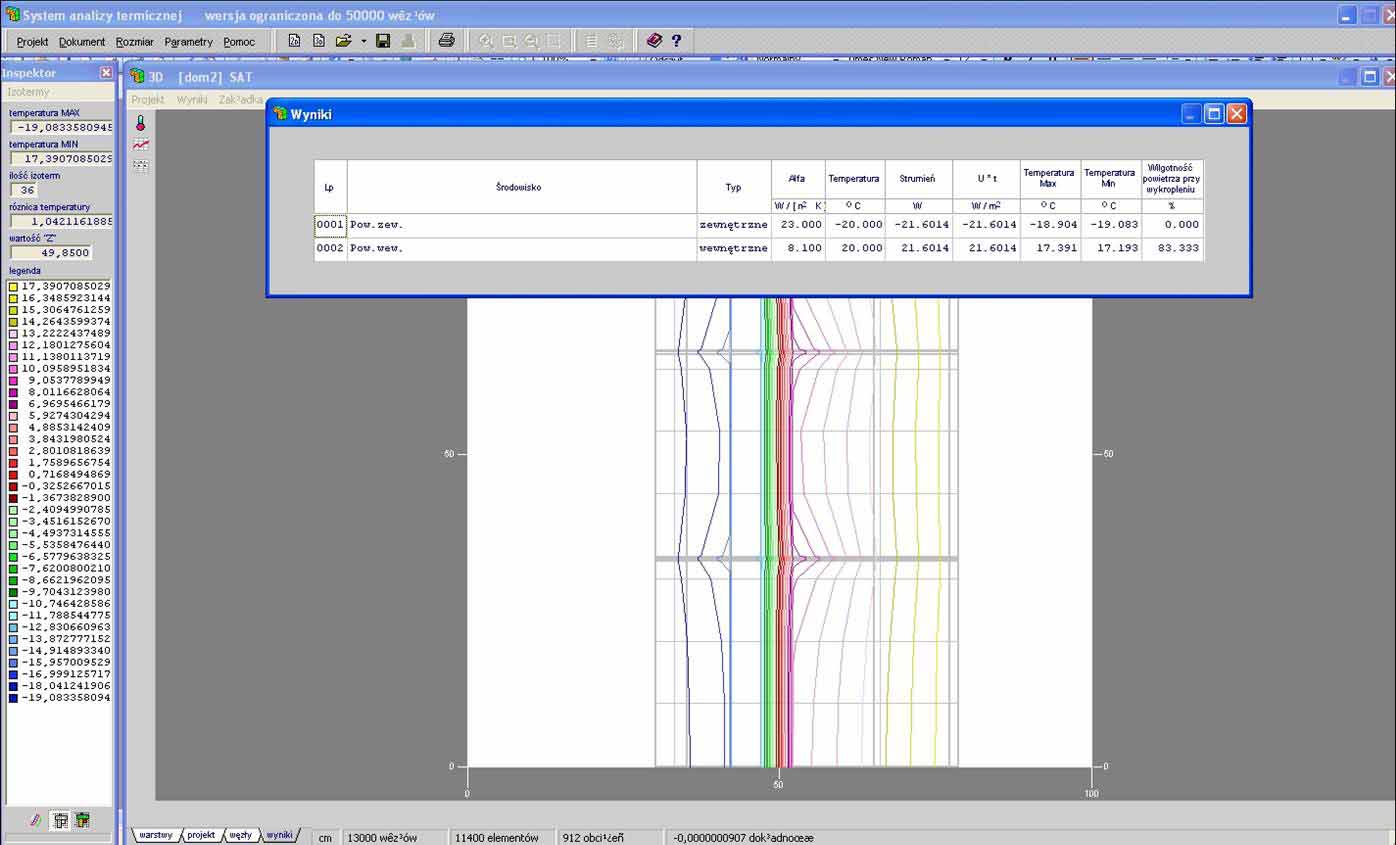
The result obtained is the result corresponding to the previous one, plus the effect of the anchors. Consequently, the Up value of a single anchor will be:
Up= (21,6014 – 20,8305) / 2 / 40 = 0,7709 W /2 /40K = 0,010 W/K
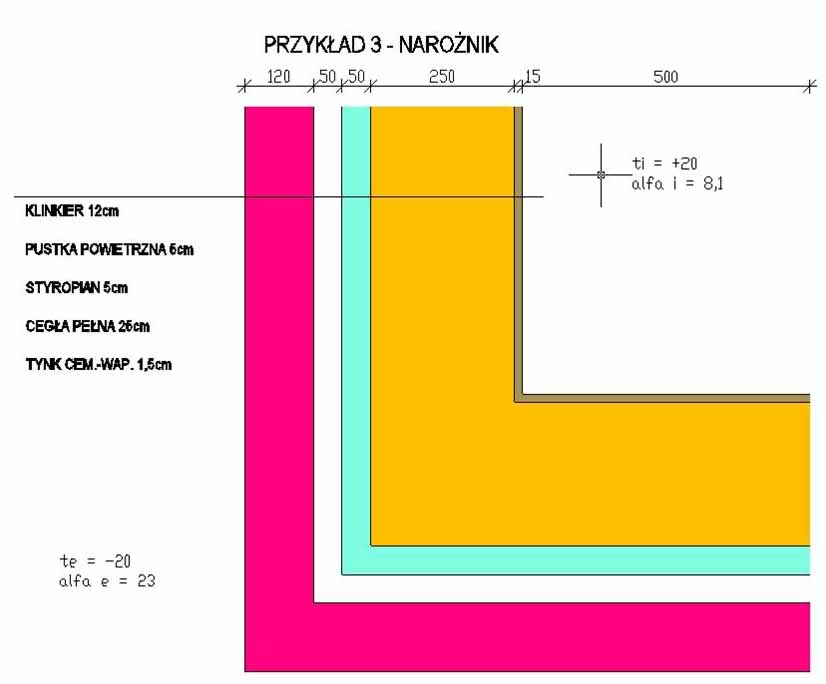
Another analyzed thermal bridge will be the corner of the same building. This case can also be analyzed only numerically or researching.
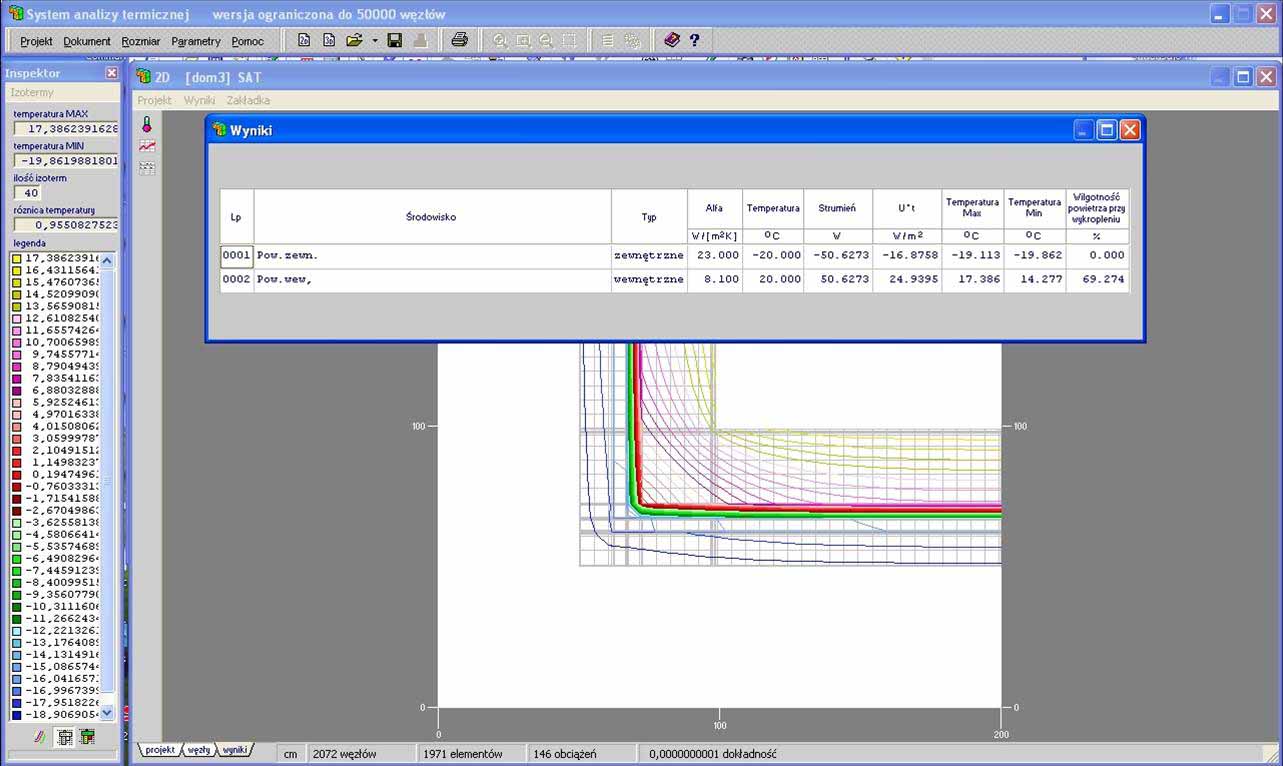
Ul = 50.6273 / 40 - 2,03 U0 = 1,2657 -2,03*0,5208 = 0,209 W / mK
attention: The distribution of isotherms tells about the extent of the thermal bridge. If the isotherms at the edge of the model are already parallel, Meaning, that we covered the entire range of the bridge with the model, unless, the model should be extended, otherwise we will get incorrect results. However, if at a distance not much farther than the modeled one, there is another thermal bridge, they should be considered together on one model as an inseparable set.
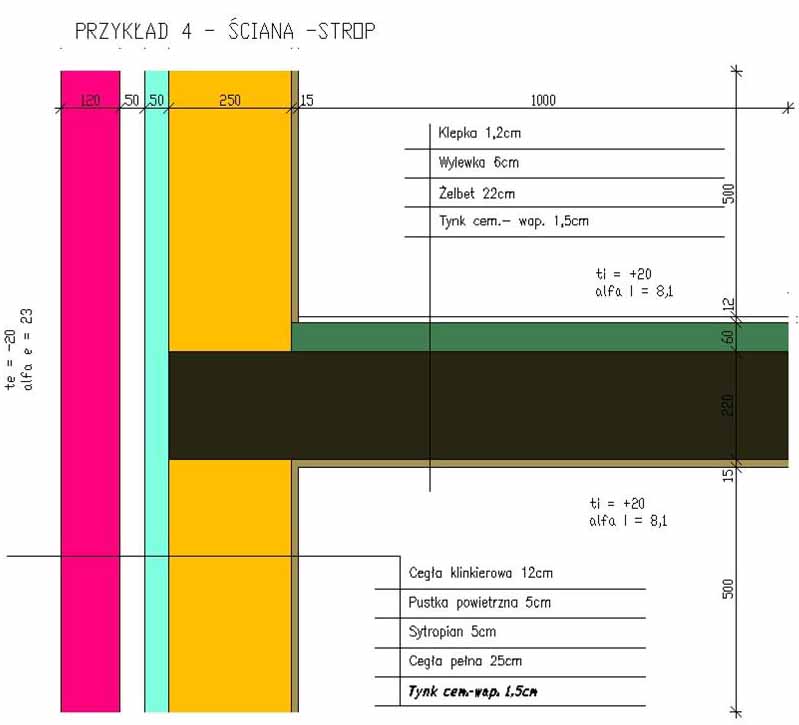
Another considered thermal bridge will be the inter-story floor. To make it easier to assign heat losses to the "floor" and "ceiling", that is, individual premises on different floors, the internal environment was divided into two.
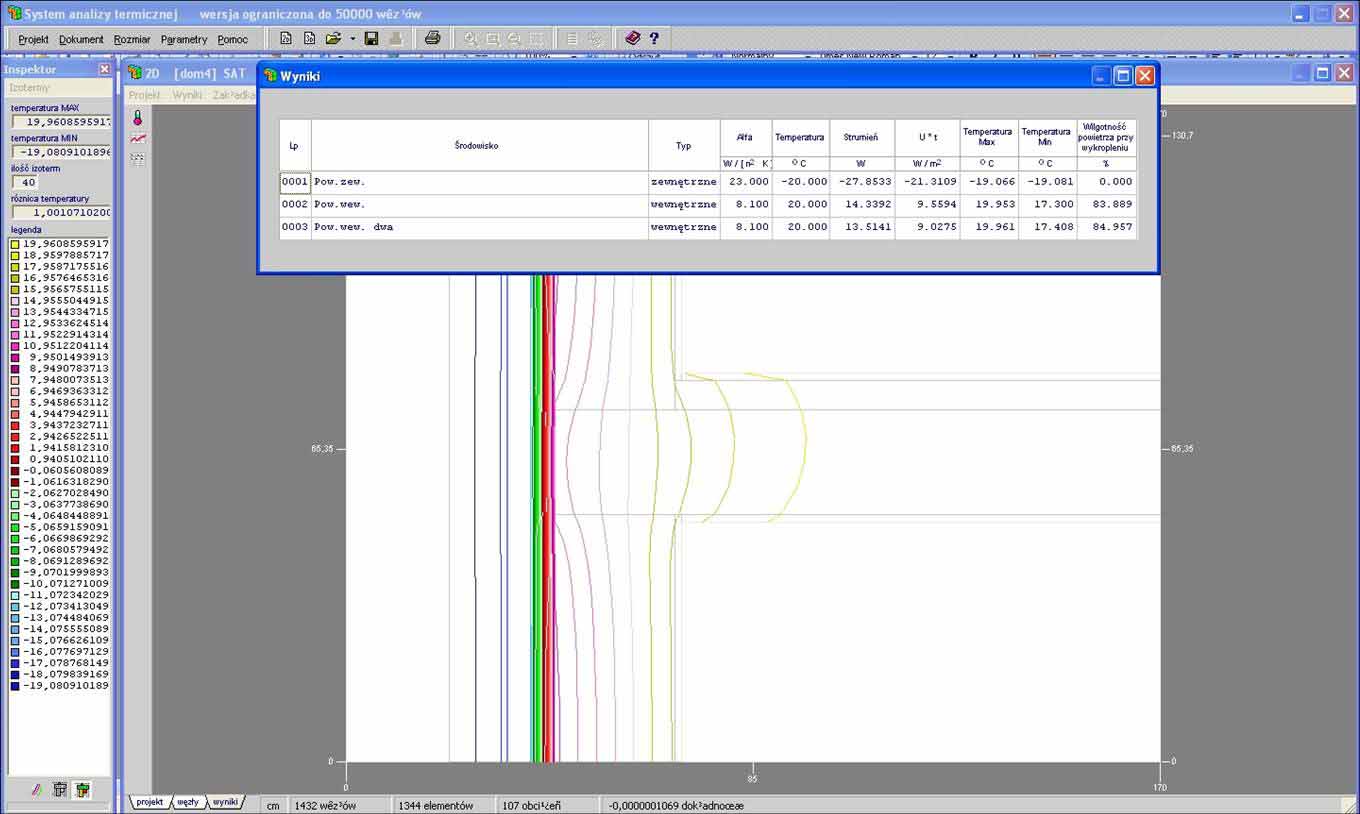
Total influence of the inter-story floor:
Ul = 27.8533 / (0,5+0,5) / 40 – 0,5208 = 0,1755 W / mK = 0,116 W / mK
Lower part influence ("Ceiling")
Wool = 14.3922 / 40 -0,5208*0,5 = 0,0981 W / mK = 0,098 W / mK
Top part influence ("Floors")
Wool = 13.5141 / 40 -0,5208*0,5 = 0,0774 W / mK = 0,077 W / mK
How easy to check the sum is correct.
It is recommended to limit the accuracy of calculations to three decimal places.