 Architecture of Italy – Early Renaissance
In the architecture of northern Europe, the Gothic style was held firmly even in the 16th century, however, in Florence it was superseded by the classically inspired Renaissance style, which soon spread throughout Wiochy. Conquest of the rest of Europe through a new style. late in time, however, was total, and the architectural language that arose at that time was not questioned until the nineteenth century and still plays an enormous role today. From that moment on, the history of architecture becomes the history of architects. Previously, large buildings were erected by stonework workshops, whose masters have rarely enjoyed wide or long-term reputation. In Italy, this system has been slightly modified by assigning famous painters and sculptors the most prestigious commissions. In the Renaissance, this trend was continued and undoubtedly was an important factor in ensuring the aesthetic appearance of more important buildings. Later, however, this method was abandoned and architecture became the domain of specialists, who were practicing this field for the first time as a profession.
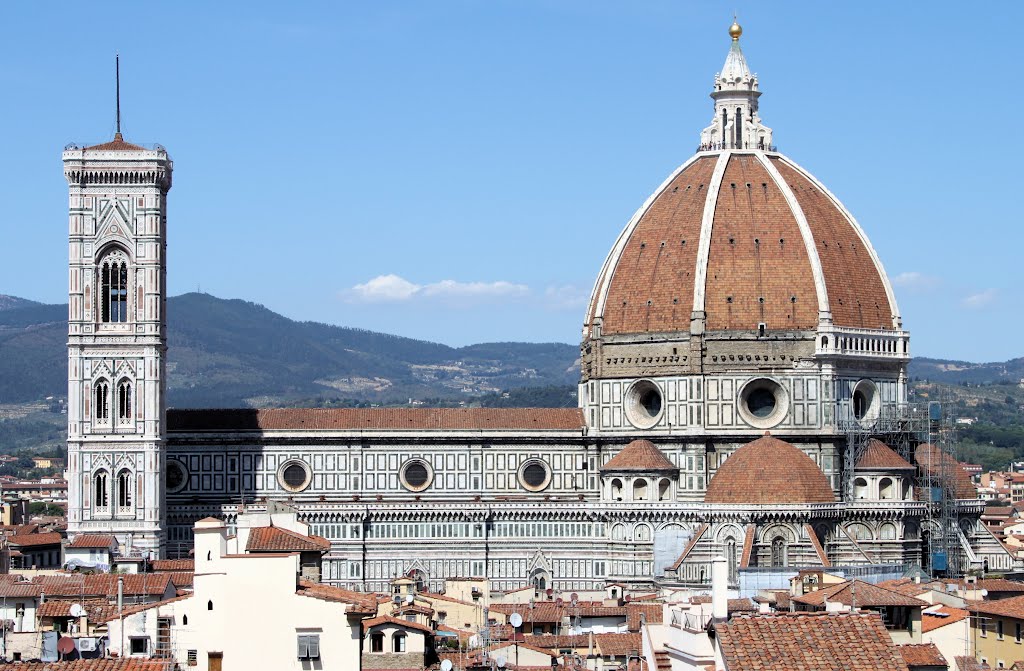
The shape of both modern architecture and the profession of an architect are in many respects the work of one man - Filippo Brunelleschi (1377-1446). Having failed in the competition for the doors of the Florentine Baptistery, he gave up his profession as a sculptor and devoted himself to the study of ancient construction methods and techniques.. As a result, he won an important local competition for the cathedral's dome. Only thanks to the restoration of the Roman method of the herringbone bricks and the invention of the appropriate lifting machinery, Brunelleschi was able to give the final shape to this essentially Gothic structure, which has since become a showcase of the city, and the dome was an unsurpassed pattern for many years.
In the most important of the buildings, which he built from scratch - Ospedale degli Innocenti. the churches of San Lorenzo and Santo Spirito as well as Capella Pazzi - Brunelleschi seem to be equally inspired by the characteristic Romanesque heritage of their native city, what about ancient architecture. His designs are majestic, but uncomplicated: they are completely original and can by no means be described as the unearthing of an earlier style.
Two other Brunelleschi inventions - a new type of city palace and a central plan in church construction - are best illustrated by the buildings designed by Micheiozzo di Bartolommeo (1396-1472). Palazzo Medici-Riccardi established the pattern of Florentine residences for the remainder of the century - a raw facade with rustic stonework on the ground floor and smooth stone blocks on the upper floors and a protruding cornice, the massiveness of the whole is balanced by the lightness of the courtyard. The apse of Santi Annunziata Michelozza, based on the pattern of a circular Roman temple, is the first Renaissance project based on a central plan; in the church of Santa Maria delle Grazie in Pistoia, the architect extended this idea to the entire building. His library in San Marco is also a kind of breakthrough - the interior layout used there with the nave and two side naves adopted for the entire Renaissance period..
Leone Battista Alberti turned out to be an even more influential creator (1404-72). Being the perfect personification of the Renaissance man, Alberti, first and foremost a writer and theorist, he was the author of the first architectural treatise since Roman times ; although he created designs for buildings, but he entrusted their execution to other architects. He showed a much greater propensity to duplicate old styles than Brunelleschi and set himself the goal of breathing new life into such Roman forms as the triumphal arch and the front facades of temples. He also formulated the theory of harmonious proportions, in which, imitating musical intervals, adopted some numerical ratios, first used in the Santa Maria Novella façade. When designing the Palazzo Rucellai, he easily solved the problem of depriving the façade of austerity and gothic character by dividing it with pilasters. However, Alberti's most original creations are outside Florence. His project of the unfinished Tempio Malatestiano in Rimini is perfect, covering the old Franciscan church with a cladding inspired by great Roman monuments in the same city. Even more splendid is the facade of the Church of Sant'Andrea in Mantua. Its elements are carefully repeated in the interior, where the aisles were boldly omitted in favor of a great nave with side chapels.