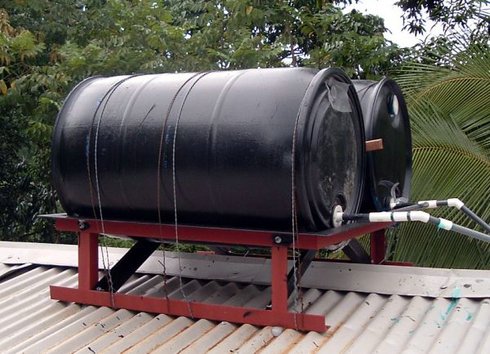
 The simplest, and at the same time the most widely used active systems, there are installations preparing domestic hot water. These systems present a varying degree of complexity: from simple portable devices to the preparation of domestic hot water, through the "bread box" - black barrels with water, placed in specially formed boxes with reflective walls, which are both collectors and hot water storage facilities, up to highly complex all-year-round hot water systems, associated with heat pumps or traditional energy sources.
In years 1979-1984 the bread box method was tested at AGH in Krakow and the test results were positive, as a method of heating domestic water.
Turned out, that it can be used from April to October inclusive, obtaining a water temperature under the most favorable conditions equal to 52 ° C. On average days the temperature ranged from 35 do 50°C, to cool and cloudy from 25 do 30°C. This method associates the greenhouse effect with the concentration of radiation. The chest should be closed after. 17, to prevent heat loss. The tested container was fine 200 dm3 of capacity and allowed to save 3215 kg of coal per year.
Correct functioning of the domestic hot water system. (domestic hot water) depends on the following factors:
— determine the time of use of the installation (seasonal or all-year-round),
- working conditions,
- additional heat source,
— proper energy storage.
The simplest is the system working on the principle of thermosiphon circulation (the heated medium rises to the upper parts of the collector, and from there to the reservoir placed by Fr. 30 — 40 cm above the top edge of the collector, causing the sucking of the cool medium from the tank to the lower part of the collector). It is also the cheapest. Its disadvantages are:
— inability to use antifreeze agents,
— no possibility to use corrosion inhibitors,
— the need to use a large accumulation tank (for approx. 10 days of demand) and a larger area of collectors.
In order to become independent from changing weather conditions, indirect water heating systems and additional heaters are used. However, in order to make the position of the collectors independent of the tank, circulation pumps are used.
The system with quick reheating of hot water operates on the principle of starting a conventional high-power heater together with opening the hot water valve. The heater is only turned on, when the water temperature is lower than required. The most economical in this system is the gas bath.
This arrangement was tested in Padeborn (northern Germany). Turned out, that by heating the hot water to a temperature of 45 ° C with 8 m2 of solar collectors and an automatically activated gas thermostat (when the water was colder than desired), can be saved compared to traditional, gas system 52% gas on an annual basis.
The system with a two-zone heat accumulator may only be used then, when we introduce high trays, in which there will be a natural stratification of water at different temperatures. Such layouts are often advertised by Western installation companies, but Polish engineers consider them incorrect in our climate.
The system with an additional accumulation tank requires greater investment outlays, but it allows the use of an additional source of less power, like for example. electric heater for "night tariff", or a coal boiler.
A domestic hot water system that works in conjunction with a heat pump increases the overall efficiency of these systems. Pump, in this case, it draws heat through the evaporator placed in the storage tank. Such a system may have two evaporators and in the event of low water temperature in the tank, the heat pump will use another, external heat source, which will ensure its high efficiency.