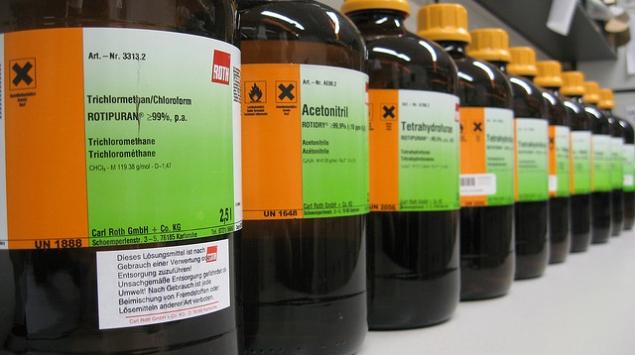
 Please explain, why the so-called. Universal thinners can dilute a wide variety of binders
The dissolving power of a solvent depends on the intermolecular forces in the solvent and the binder being dissolved. Both individual groups of solvents, and different binders have very different intermolecular forces. Universal thinners contain quite different solvents with different intermolecular forces. Only some of these solvents can dissolve a specific binder. The remaining solvents contained in the liquid only act as inert diluents. In the case of a different binder, other solvents may dissolve them, while part of the content is only the diluent.
What is meant by solvent volatility?
The volatility of the solvent is a proportional indicator, informing, how much time a certain amount of solvent needs to evaporate compared to the same amount of diethyl ether. Diethyl ether is volatile 1. So if, for example,. acetone is volatile 2,1, it means, that a certain amount of acetone needs to evaporate 2,1 times longer than the same amount of diethyl ether. Diethyl ether is often simply called ether. This is wrong, because ethers are a whole group of solvents, and diethyl ether is just one of them.
The volatility is respectively for:
a) eteru dwuety lowego – 1;
b) acetonu -2,1;
c) terpentyny – 38;
d) benzyny lakowej – 60;
e) wody – 80.
Solvents are divided into groups depending on their volatility. Please list these groups and state the volatility range for each of them
Solvents are classified into readily volatile (volatility below 10), moderately volatile (of 10 do 35), hardly volatile (of 35 do 50) and very difficult to fly (above 50).
Why, as a rule, easy mixes are most suitable for varnishes and paints, medium and low volatile solvents? Varnishes and paints should set quickly after application, but at the same time have good flow. This can best be achieved by appropriate mixing of the various solvents. Easily volatile solvents evaporate quickly; as a result, the applied varnish thickens and e.g.. no streaks appear when painting vertical surfaces. Medium and non-volatile solvents evaporate more slowly, and the paint may still melt. Solvents can also evaporate from the deeper layers of the coating without leaving "craters" in the painted surface.