 Architecture of Italy – THE ROMAN PERIOD
In architecture, as in many other areas. The Romans borrowed and adapted Greek patterns. However, as with other art forms, their views on construction differ greatly, especially in favor of order and functionality over beauty. Functional materials were preferred and only from the reign of Emperor Augustus, when the face of Rome was greatly watered down, the use of marble and stucco can be seen, but then only as cladding. Though three Greek orders were used (with a particular fondness for Corinthian. with a pommel decorated with acanthus leaf) and two more new ones were invented. The Romans took the structural role given to the column by the Greeks, using this element only decoratively. Instead, they focused on the rounded forms of the hatch and dome, paying special attention to the solution of load-bearing walls. One of the major contributions of the Romans to the development of architecture was the vault. The use of concrete. rather than wooden load-bearing structures made it possible to create much more spacious interiors, and much higher than any Greek building; their achievements in this regard were surpassed only in the 19th century. Thanks to this, they had the opportunity to create architecture that perfectly embodies their great aspirations.
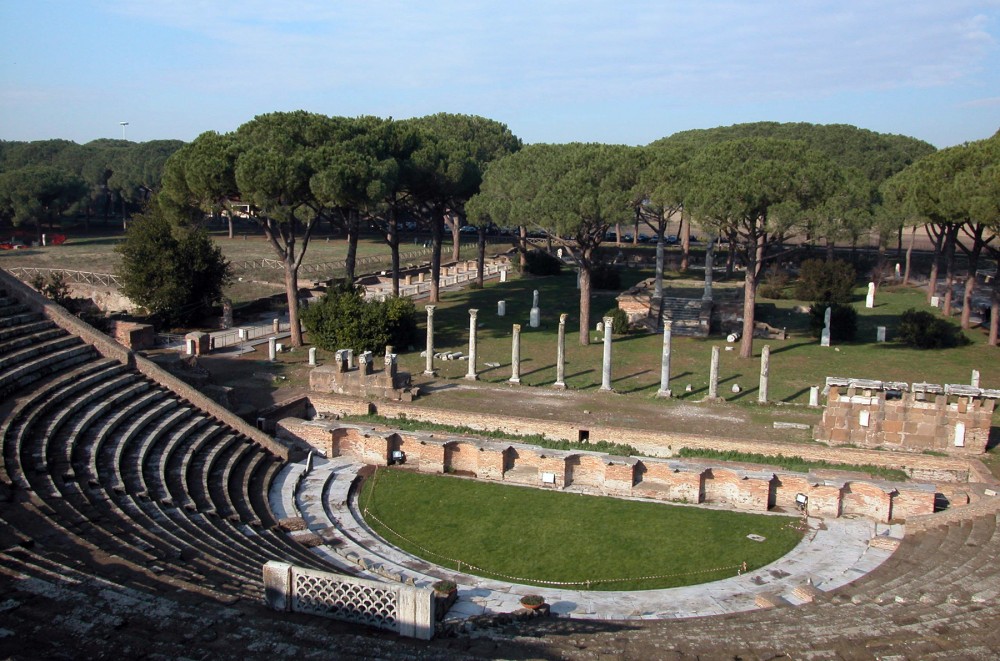
Roman architecture used to dominate all of Europe, showing no significant regional variants. therefore, many of its most magnificent individual monuments are now outside Italy. However, the most important monuments can be found in Rome, its original seaport of Ostia and Pompeii and Herculaneum (which were flooded with lava as a result of the powerful eruption of Mount Vesuvius). The heart of the Roman city was the forum, a square usually located at the intersection of two main streets. All aspects of public life were concentrated in the buildings located there: religious worship, policy, law, finances, trade, shopping and socializing. Over time, the square became too small. to fulfill all these functions: an extreme example of this is the Roman Forum. mainly from the period of the republic, so successive emperors found it necessary to build new forums elsewhere in the city.
There were usually many temples in each forum, outstanding examples of which are preserved in Palestrina, Tivoli, Assisi and Brescia. At first, the temples followed Greek patterns, with an emphasis on the front facade, often with stairs. Later, the circular plan was used more and more willingly, for example, in the temples of Vesta in Rome. The circular plan was also chosen for the Roman Pantheon, which is not only the largest of all temples and the only completely preserved building from the time of the empire, but also one of the masterpieces of engineering and architecture of all time, and its dome still ranks among the largest in the world.
The main public building in Roman cities was the basilica, place of assembly and seat of government. In many ways, the basilica looked like a cross-over Greek temple and consisted of a great hall ended with an apse. vaulted, sloping aisles (lower than the main one), often with galleries. No complete examples have survived in Italy, but some idea of the development of this type of building can be gained by visiting the basilicas of Trajan and Maxentius in Rome, which are two centuries apart. The first one has a colonnade and a flat one, wooden roof. while the second (which is clearly visible in the preserved aisle) it had a solid concrete vault supported by five massive pillars.