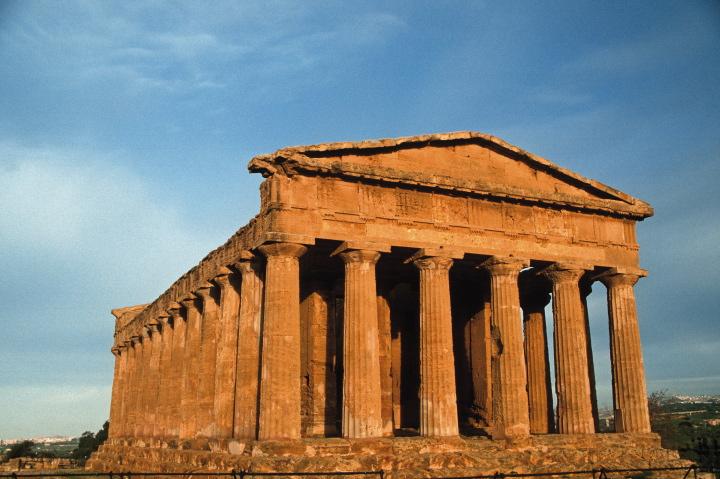
 While the architecture of Italy was not as invariably influential as painting and sculpture, however, it is the country that boasts an outstanding heritage of historic buildings, an almost uninterrupted tradition reaching over 2500 years back. Just like in other arts, Strong regional differences are evident in all major periods in the history of architecture.
GREECE AND ETRUSCAS
The earliest of the important buildings preserved in Italy was erected by Greek settlers in the 6th century, p. n. e. These buildings exhibit the same features, which characterized classical architecture in Greece itself; strong but simple outline, strict adherence to balanced proportions, total compositional unity including a logical system of verticals and levels as well as a wide use of decorations to emphasize the structure. This architecture, mainly using marble as a raw material, was based on the three great classical orders, consisting of a column, sometimes supported on the base, topped with a head and a beam made of architrave. cornice and frieze.
The most sublime and simplest of the three styles was the Doric order. used in temples, which are the pride of Greek architecture, dedicated to the gods, and yet built on a human scale, never too tall or overloaded in any sense. A beautiful ensemble of these buildings on the Apennine Peninsula can be admired in Paestum; the rest - in Agrigento. Selinunte. Segesta and Syracuse - located in Sicily. They are older and less sophisticated than the Athenian Parthenon. but in terms of conservation status, they can compete with all buildings in Greece. What is characteristic, That is why the Temple of Concord in Agrigento survived, that she was turned into a Christian Church, while the Temple of Athena in Syracuse was incorporated into the cathedral, where it still remains.
The Greeks were also avid builders of outdoor theaters, usually located on the slopes of the hills, with seats for spectators carved out of the rock. The Greek Theater in Syracuse is one of the best preserved buildings of this type from this period; theater in Taormina from the same time, beautifully situated against the backdrop of Mount Etna, it was also erected by the Greeks, but the Romans rebuilt it considerably.
A completely different type of architecture was practiced by the Etruscans in central Italy at the same time, who preferred to use the great ones, cyclopean stone blocks. Unfortunately, few above-ground monuments of Etruscan architecture have survived, for the Roman conquerors carried out a program of systematic devastation of it. The few surviving examples include the city walls of Volterra and Cortona from the 6th century B.. n. e. and gates in Volterra and Perugia, formed three centuries later. However, numerous Etruscan tombs have survived, mainly in Cerveteri and Targuinia in northern Lazio.