 Architecture of Italy – Romanism
The emergence of Europe from the darkness of the early Middle Ages in the 10th and 11th centuries is associated in architecture with the Romanesque style, which in Italy draws abundantly from the country's own heritage. Features rarely found in other countries include adherence to the basilica plan and the cupolas crowning the domes, use of marble cladding, the presence of separate campaniles and baptistery and the use of the arch for decorative purposes, and not only purely structural.
Regional varieties are very distinct. The churches in the Lombardy Lowland most closely resemble those of North Europe and were among the most imitated outside the country. Their most dominant features are tall, dignified towers, devoid of buttresses and decorated with pilasters. A vaulted portal on the shoulders of lions protrudes in front of the facade line, above which there is a rose constituting the main source of illumination of the nave. Not counting the facade, the decoration is concentrated in the apse, where there is often an open gallery and corbels delicately decorated with grotesque heads. Sometimes a revolutionary rib vault was used for that day. The cathedral in Modena stands out in particular, just like the characteristic trios consisting of a cathedral, campanili and the baptistery of Parma and Cremona.
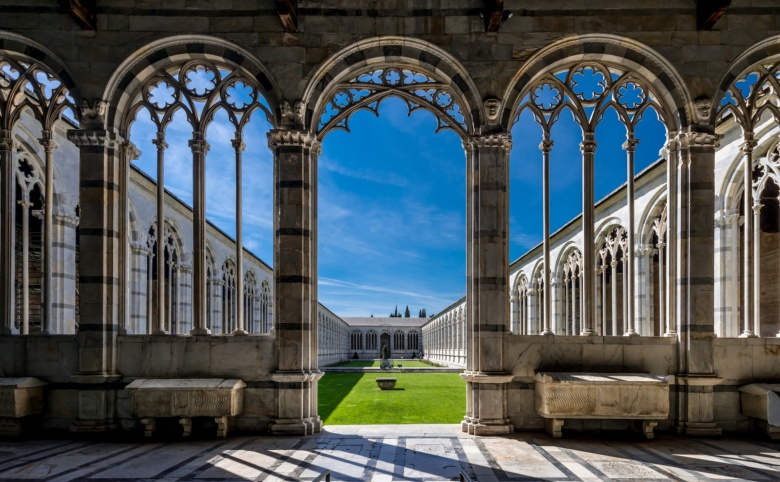
The characteristic Pizza style dominates the above-mentioned monuments. examples of which can be found all over the city, but it is especially strongly associated with Piazza del Duomo, where a cemetery is added to a typical three-part group (Cemetery), all in a green scenery away from the shopping center. Although the construction of this complex began in the mid-11th century, and only finished 300 years later, it is characterized by a surprising unity of style. All buildings are clad in marble and have arcaded galleries on the outside (so designed, for spectacular lighting effects) façades reaching up to the top and surrounding the entire building. Quite the same was built in the neighboring cities of Lucca and Pistoia.
An even more characteristic Romanesque style can be seen in the oldest surviving buildings in Florence - the baptistery, San Miniato i Santi Apostoli, and Badia in Fiesole. The general arrangement of these buildings is quite typical of those times, but the constant use of mosaics and marble cladding indoors suggests Byzantine influences, and the overall elegance of the form indicates that it is based on Roman patterns.