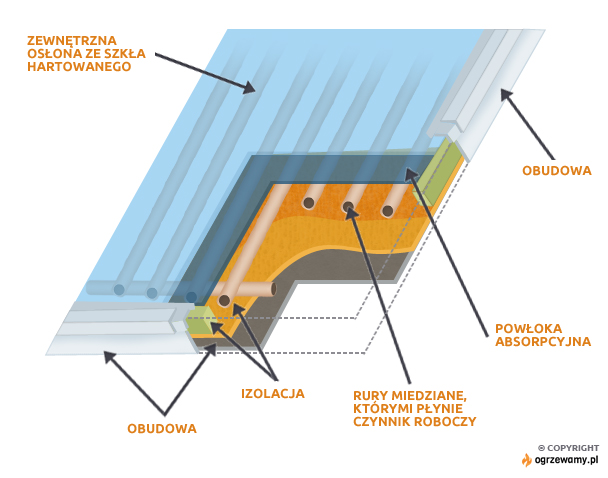
 Thermal insulation is designed to limit heat losses to the environment through the rear and side walls of the collector. Apart from low thermal conductivity, it should be non-absorbent, resistant to elevated temperatures and high mechanical strength, so you can resign from constructing rigid walls on the bottom of the collector.
Currently, rigid polyurethane foam and expanded polystyrene are most often used.
The collector frames are a stiffening structure, which permanently connects all the elements of the collector and allows you to assemble the collectors as modules into large sealed fields.
Frames made of aluminum profiles are most often used; there are also frames made of galvanized steel, made of wood and plastic.
The working medium in flat plate collectors is water or 50% ethyl glycol water solutions, or propylene glycol. Liquids with a reduced pour point are also used, designed for cooling car engines.
Low boiling point liquids are used in some embodiments, amounting 30 — 60°C. Collectors with such a working medium require a special heat exchanger in each collector, in which the boiling liquid gives off heat to the flowing water. To reduce heat loss to the environment, caused by convective air movements inside the collector, in some types of flat plate collectors a vacuum is created between the absorber and the covering material. Thus, gains in the efficiency of the collector of up to 80%, but the production technology is much more complicated here, and therefore more expensive.
In professional literature, as well as in prospectuses of various companies, the concept of efficiency is used to define the functional properties of the collector. Efficiency is the ratio of useful energy (received) from the collector through the working medium up to the total intensity of solar radiation reaching the collector's surface.
Vacuum collectors with an absorber covered with selective and focusing paints are most efficient, following the movement of the sun.