The methods of stabilizing a given system or structural system depend primarily on the nature of the damage. In principle, the inhibition of rotation processes and the fusion of load cells can be achieved by three methods:
— by introducing reinforcements that do not violate the basic static scheme of the system,
— z wprowadzeniem konstrukcji zmieniających schemat pracy statycznej stabilizowanego układu,
— z wprowadzeniem nowych elementów pracujących jako niezależne i samodzielne konstrukcje.
In any case, the technology of the enhancement treatment should be carefully thought out in terms of purposefulness and technical effects, feasibility and convenience of execution and in terms of economy, the design and performance criteria will be decisive here.
The strengthening technique in this case consists in increasing the load-bearing capacity of a given structural element or system by enlarging the working cross-section. This can be achieved by means of reinforced concrete clamps and shells, introduction of additional reinforcement or steel elements, ceramic cladding on the element, cutlery etc..
The use of these technological treatments takes place mainly in such cases, when more favorable operating conditions of the system are obtained by reinforcement or when there is a need to quickly incorporate the reinforced structure into the spatial operation of the system, or when the application of this method will avoid larger ones, more time-consuming work.
Most often, this method is used to strengthen and stabilize such structural elements, like domes, vaults, arcades, maybe, poles, columns, pillars, foundations for walls and column supports.
Normal and reinforced concrete are the basic materials for strengthening the structure by increasing the cross-section, brick or stone, and sometimes steel sections. The main problem when using strengthening treatments will be to create appropriate conditions for the cooperation of the old structure with the reinforcing elements. When using concrete, particular attention should be paid to the issue of adhesion and monolithicity of joints. For this purpose, the surfaces of masonry structures should be cleaned of dirt at the joints, dust and crumbly parts, all scratches and cracks washed and carefully filled with mortar, then the surface is washed off with water and moisturized abundantly. A mesh or reinforcement is placed on the substrate prepared in this way and the required concrete layer is imposed on it manually or with the use of a shotcrete. Defects and places, especially weakened, are previously filled with concrete or masonry. In the case of strengthening the vaults, of domes or arches, the reinforcement should be anchored in the wall with appropriate bars.
It must be noted, that the execution of the strengthening works in the discussed method should be particularly careful, taking the necessary precautions. When cleaning the surface and removing damaged parts, check the load-bearing capacity of the weakened sections and design and perform stamping and formwork accordingly.. A lot of attention should also be paid to the selection of the concrete mass, especially when strengthening with thin reinforced concrete coatings.
The technique of strengthening load-bearing structures without disturbing the basic structural scheme is quite commonly used in practice, many monuments were also strengthened in this way. Among other things, this method was used to strengthen the renaissance vaults in the "chambers above the gate" in the west wing of the Wawel Castle.
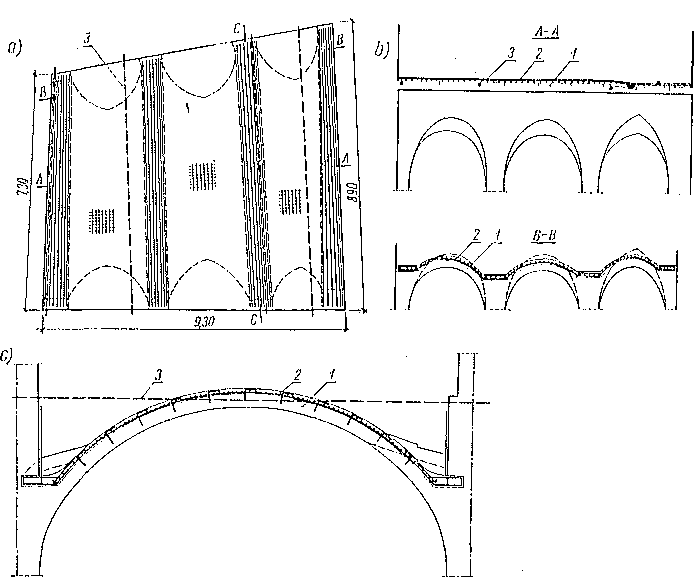 Strengthening the vault of the room above the entrance gate of the Wawel Castle, beginning of the 16th century: a) vault projection, b) longitudinal sections, c) cross -section 1 - brick vault, 2 - reinforced concrete coating with a thickness of. 6 cm, 3 - old stitches preserved
The technical condition of the vaults was extremely bad, mainly due to loosening of joints and mortar chipping. This caused bricks to fall out, and consequently deformations and dangerous cracks arose. The load-bearing capacity of the vaults turned out to be insufficient to fulfill the functional functions. Rebuilding the vaults was out of the question, because they were original relics of building technology from the Renaissance period.
The concept of reinforcement consists in covering the vaults with a thin reinforced concrete coating, done this way, that it cooperates with a brick vault as a composite system.
The results of the application of the discussed method can also be illustrated on another example, namely - the treatment of strengthening the pillar of the nave in the NP Maria church in Gdańsk.
During the war, the roof and most of the vaults of the central nave were destroyed in the aforementioned building. These vaults were reconstructed without any detailed recognition of the supporting values of the pillars, on which they were based. After completion of the works and removal of the scaffolding, one of the pillars between the nave and the aisle began to deform and scratch dangerously. The resulting bulges and scratches threatened with the collapse of the vaults due to the loss of the pillar's bearing capacity. Closer research revealed, that in the interior of the pillar, the mass of brick and mortar was distributed as a result of seepage of atmospheric water and the action of frost. This resulted in a decrease in the strength of the materials, which in turn was the cause of the situation.
Under the existing conditions, it was not possible to proceed with the regeneration of materials or the demolition of the pillar, because the deformities were serious and the emergency condition required immediate intervention. In connection with, after securing the vaults with erected scaffolding again, the pillar was strengthened by covering the shaft with a reinforced concrete coating, which tightly embraced the entire pillar around the perimeter. This procedure allowed not only to strengthen the weakened cross-section of the pillar, but also increase the load-bearing capacity and stability of the system as a whole. At the same time, this type of reinforcement made it possible to avoid very expensive works, necessary in the event of the demolition of vaults and pillar.