Depending on local conditions, the following may be considered as security measures for buildings erected on land with anomalous features:
1. Zastosowanie stabilizacji samego gruntu, in particular, the introduction of measures to maintain a specific humidity regime in the active zone of the ground and prevent changes in its volume in this way.
With regard to clayey soils, the issue comes down to securing the substrate against changes in humidity, which can both be related to preventing the soil from drying out, as well as its excessive hydration.
Based on observations it was found, that under certain conditions trees reduce the amount of water in the ground, mostly deciduous, growing near the building. Therefore, to maintain proper humidity, and thus the stability of the mechanical features of loams, it is recommended to remove the deciduous stand from the endangered area to a distance equal to at least one or one and a half crown heights.
Maintaining constant humidity conditions in the substrate can also be achieved by means of a horizontal screen of an appropriate structure.
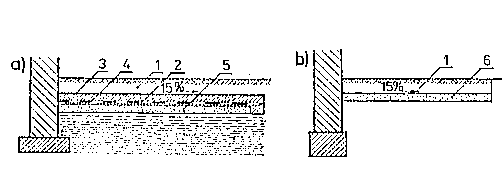 Securing a specific humidity condition with a horizontal screen
1 - a layer of plant soil with a thickness of. 30 cm, 2 — zuzlobeton grub. 15 cm, 3 — asfalt grub. 2 cm, and - lean concrete with a thickness of. 5 cm, 5 - sand with a thickness of. 15 cm, 6 - ground stabilized with tar with a thickness of. 15 cm.
Such a screen is placed around the building just below the surface of the regulated area. It may be a ground layer stabilized with bitumen, concrete slab with asphalt insulation and other l00). The insulating screen effectively protects the substrate against changes in humidity, as well as the effects of temperatures.
2. Zastosowanie stabilizacji pośredniej gruntu za pomocą pionowego ekranu wodoszczelnego otaczającego zagrożony obiekt. Such a screen dropped to a suitable depth into the ground in the form of a steel sheet piling, wooden or reinforced concrete elements, or made in a trench filled with a suitable natural or mixed sealing material, covers the ground, on which the building rests, stops groundwater movements and resists ground deformation.
This method was successfully used to secure the building of the Town Hall in Kłodzko. The Town Hall building is founded on loess sediments with a thickness of approx 12 m. Below this layer there are sand and gravel layers. Attempts to save the building from a failure due to ground movements have been made many times, but none of the ways stabilized the ground and the building was deformed more and more. Therefore, to inhibit the destruction of the building, it was decided to surround the Town Hall building with a sheet piling, made of steel Larsen sections. The wall was driven in approx. 5,0 m from the outer outline of the walls, breaking through the loess layer as far as the solid substrate, thus isolating the ground under the building from water influences, a. At the same time, its sideways displacement was prevented under load deformation. As observations show, the use of a tight bulkhead completely eliminated the collapse of the area limited by the wall and stabilized the building structure; no scratches or deformations have been observed for several years.
In clayey soils, a similar role can be performed by waterproofing in a trench. Isolation of building foundations, At risk of deformation from the native soil, it can reduce the deformation of the structure caused by shrinkage or swelling of the soil.
3. Spetryfikowanie gruntu pod fundamentami, if the type of land allows it. Petrification can be effectively achieved by chemical injection, of cement, bituminous, electro-osmotic, and also with the help of thermal processes.
In the case of loess soils, elimination of local collapse while strengthening the soil can be achieved by silicization. For this purpose, a sodium silicate solution is introduced under pressure into the borehole (water glass). With proper groundwater filtration, this solution chemically reacts with the soil, binds it and hardens it, thereby increasing the mechanical strength and stability.
The thermal method, in turn, is about this, that air heated to a temperature of 600-800 ° C or various gaseous chemical preparations are blown into the borehole, which burns up inside the hole. The thermal method is especially suitable for strengthening the ground underneath foundations.
However, it should be emphasized here, that the choice of method in any case depends on the properties of the substrate and should always be determined by specialists .
As for the means and methods of securing buildings or their structures, the following treatments may be considered:
a. Lowering the foundation of the building below the active zone of the ground down to the bearing layer using: foundation foundation, supporting foundations on drilled or pressed piles, supporting the foundations on wells or other.
b. The use of structural measures in the building to increase its spatial stiffness or to reduce its deformability.