 The size of heating costs for single-family houses is influenced by the choice and application of energy-saving solutions for external partitions. About 10% of all heat losses in these houses is the heat transfer from the buildings to the ground. It is worth taking care of it, so that as much heat as possible remains inside the house and use it to heat the rooms, not paying for heat, which is not used.
The type and thickness of the insulation used in the floor on the ground as well as the care and accuracy of its execution – these are the factors that determine the amount of heat loss in this way. The greater the thickness of the insulation, the more heat the floor can keep inside the house.
Most often, there are two basic solutions for floors on the ground: concrete subfloor or joist flooring.
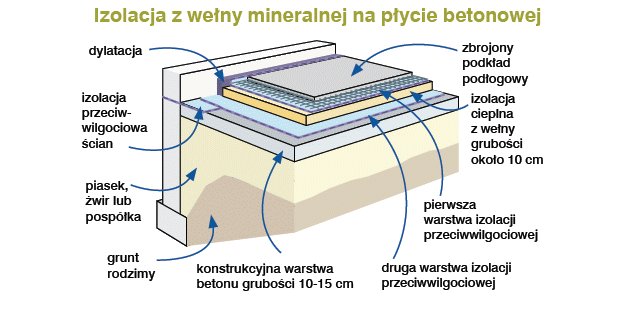
The floor on a concrete base in an energy-saving building.
In an energy-saving house for rooms, in which we want to obtain an internal temperature above 16 ° C, floor insulation should be laid on the ground, for which the value of thermal resistance R = d / λ will be higher than 2,5 m²K/W, (d – material layer thickness given in meters divided by λ – its thermal conductivity coefficient). The correct arrangement of floor layers according to the energy-saving ROCKWOOL standard should be as follows (viewed from underneath):
• grunt rodzimy,
• zagęszczona podsypka z gruntu piaszczystego o grubości min. 15 cm,
• lean concrete with waterproof insulation as required,
• ocieplenie z płyt STROPROCK gr. min. 10 cm, arranged in one layer on a passing pattern,
• podkład betonowy o grubości 4 cm, laid directly on the STROPROCK boards or on the foil with overlaps (as needed). The use of the foil depends on the consistency of the poured concrete base and the floor conditions.
The floor on a concrete base in a passive house.
In a passive house for rooms, in which we want to obtain an internal temperature above 18 ° C, floor insulation should be laid on the ground, for which the value of the thermal resistance R = d / λ will be greater than 10 m²K/W, (d – thickness of the material layer given in meters divided by λ - its thermal conductivity coefficient).
The experimental layering of the floor should be as follows (viewed from underneath):
• grunt rodzimy,
• zagęszczona podsypka z gruntu piaszczystego o grubości min. 15cm,
• izolacja przeciwwilgociowa (bucket membrane),
• ocieplenie z płyt STROPROCK gr. 18 cm, staggered in two layers, p,
• zbrojenie oraz beton klasy B-20 o grubości 15 cm
• ocieplenie z płyt STROPROCK gr. 18 cm, lay in two layers on a passing pattern,
• izolacja przeciwwilgociowa (construction foil with a thickness 2 mm),
• chudy beton z izolacją wodoszczelną i zbrojeniem,
• płytki ceramiczne.