Izokorby
Efficiency of "isocorbs" in the elimination of linear bridges.
"Izokorba" is a translation of the German word "Isokorb" for a structural and insulating element. It is used to break the heat flux path in a structural element (most often the balcony) while maintaining the continuity of the structure. Therefore, it is made of rigid elements, keeping distance on the compressed side, tension bars on the tension side, bars bent under shear forces, and spaces in between, are filled with insulating material - polystyrene.
As ordinary reinforcing steel corrodes and its thermal conductivity coefficient is 50W /(mK) in the sensitive section, stainless steel - stainless steel and with a significantly reduced λ value was used (according to the supplier 15W /(mK)).
Fig. 1. Element of the isocorb - top view.
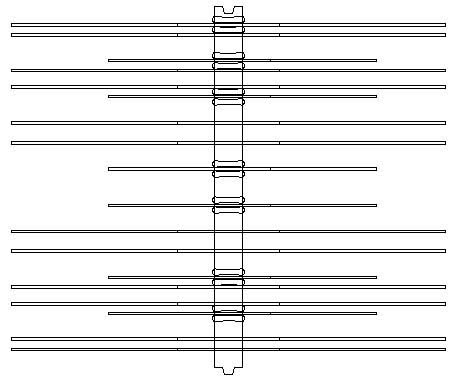
Fig.2. Isocorb element - sectional view.
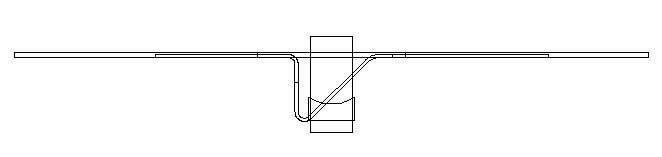
To sum up: isocorb is an element changing the linear bridge of a continuous reinforced concrete structure - e.g.. balcony slab fixed in the ring, into a point bridge complex with a much smaller cumulative effect.
In order to check the operation of the isocort, we analyzed its thermal operation using a substitute material in the place of the isocort. The thermal conductivity coefficient of the replacement material is provided by the manufacturer. This action allows you to speed up the calculations, because it allows you to use a 2D model instead of a 3D.
We conducted the analysis on a fragment of the spatial model, because we wanted to have a ready-made model to check later if the replacement element corresponds to the spatial thermal work of the isocorb.
Fig. 3. Modeled 2D system with the isocapper replaced with substitute material.
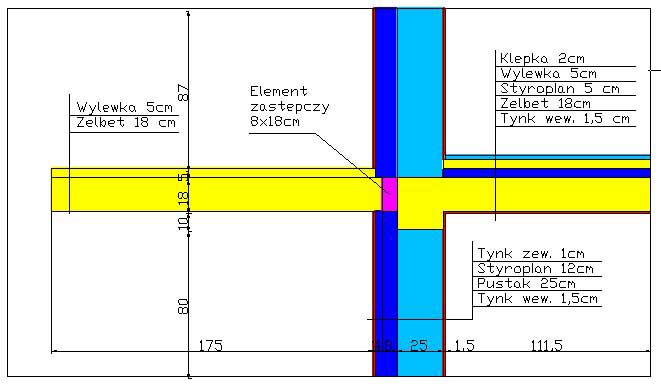
Model _24.sat
Outside temperature -24. The length of the 3D model 0.1m.
Placeholder (in accordance with the manufacturer's recommendations) in the place of the isocorb.
Pic.4. The system of isotherms in the 2D model with the isocorb replaced with a substitute material.
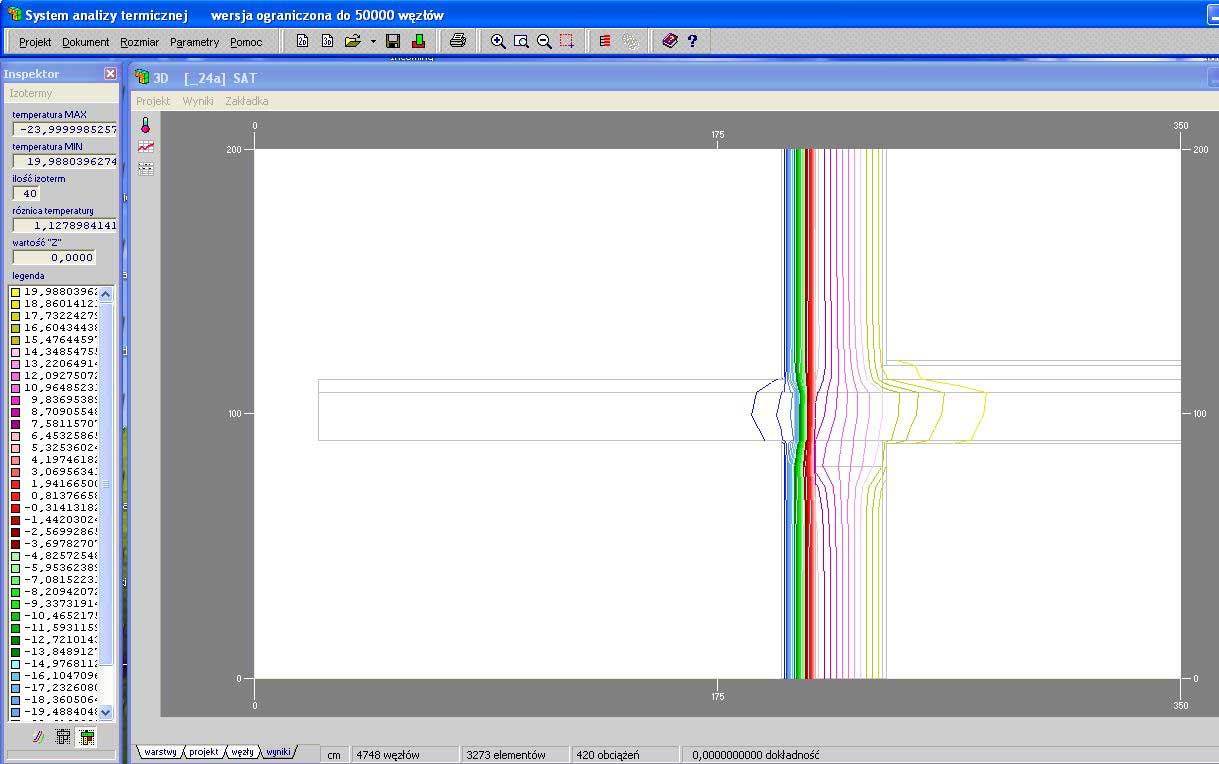
The stream for the bridge is 1m long
28,17 W
U=0,2236 W/(m2K)
Ψio=28,17/44-2*0,2236=0,193 W/(mK) - in relation to the internal surface. gross dividers
Ψi =28,17/44-1,685*0,2236=0,263 W/(mK) - in relation to the internal surface. net baffles
We analyzed the same model for the following temperatures of the external environment, i.e.. -22, -20,-18 i -16 st. C.
Summary of calculations for a slice of the spatial model, taking into account the isocorb substitute material.
|
Temp. pow. outside. |
-24st.C |
-22st.C |
-20st.C |
-18st.C |
-16st.C |
|
Temp. min. inside. |
16,014 st.C |
16,195 st. C |
16,377 st. C |
16,240 st.C |
16,739 st.C |
|
Condensation with relative humidity. |
77,7 % |
78,2 st. % |
79,2 % |
80,3 % |
81,2 % |
|
The value of the stream for the 1m.b model. 2m wys. |
28,170 W |
26,89 W |
25,609 W |
24,329 W |
23,048 W |
The value of the linear heat transfer coefficient calculated in relation to the net internal surface Ψi = 0.263 W /(mK)
The value of the linear heat transfer coefficient calculated in relation to the gross internal surface Ψio = 0.193 W /(mK)
attention: Let's remember, that these are the results for this particular model and cannot be directly adapted to other situations.
For comparison, we analyzed the balcony in the traditional version, i.e.. 5 cm of polystyrene with insulation of the entire balcony area without isokorba.
Lynx. 5. Comparative model - traditional.
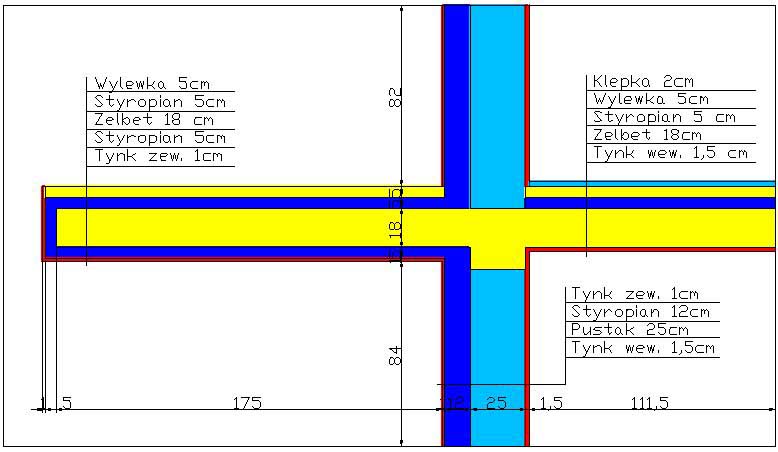
Traditional balcony insulated with 5 cm of polystyrene on 100% surface.
Outside air temperature equal to -24 degrees Celsius.
Lynx. 6. System of isotherms. Comparative model - traditional.
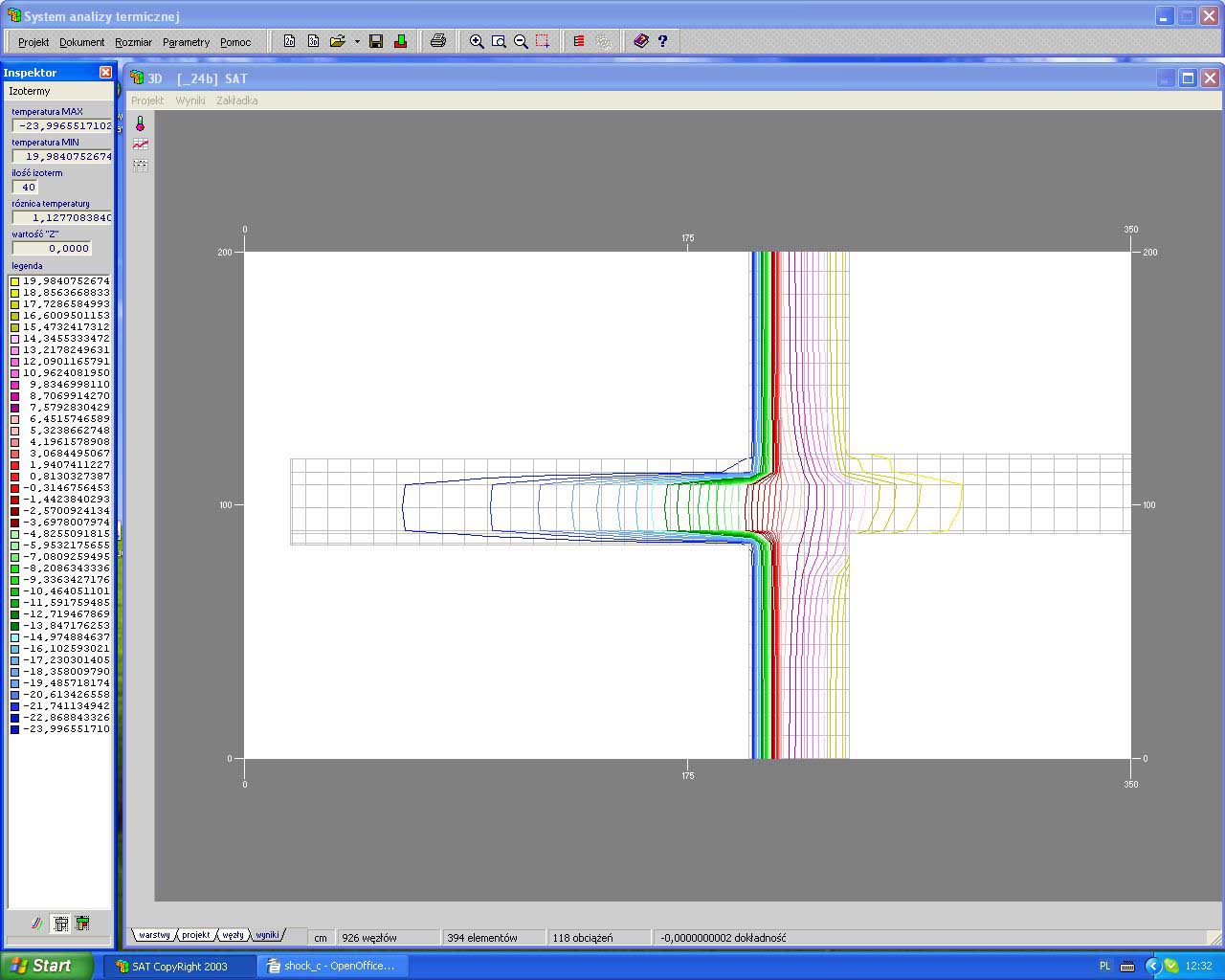
Flux for a bridge length of 1m = 33,252 W.
U=0,2236 W/(m2K)
Ψio=34,520/44-2*0,2236=0,337 W/(mK) - in relation to the internal surface. gross dividers
Ψi =34,520/44-1,685*0,2236=0,408 W/(mK) - in relation to the internal surface. net baffles
Calculation summary for a section of a spatial model with a traditionally insulated balcony, 5 cm thick polystyrene.
| Temp. pow. outside. |
-24st.C |
-22st.C |
-20st.C |
-18st.C |
-16st.C |
| Temp. min. inside. |
14,057 st.C |
14,327 st. C |
14,597 st. C |
14,867 st.C |
15,138 st.C |
| Condensation with relative humidity. |
68,333 % |
69,701 st. % |
70,641 % |
71,966 % |
73,376 % |
| The stream value for the model |
34,520 W |
32,295W |
31,382 W |
29,819 W |
28,244 W |
The value of the linear heat transfer coefficient calculated in relation to the net internal surface Ψi = 0,408 W/(mK)
The value of the linear heat transfer coefficient calculated in relation to the gross internal surface Ψio = 0.337 W /(mK)
Assuming the values of Ψio = 0.193 W /(mK), Ψi=0,263 W/(mK), that is, it is the reduction of the influence of the linear bridge by respectively 43% i 36% 5 cm of polystyrene in relation to standard balcony insulation. The size, which should be indicated as reference should be 36%, as it refers to the heated area of the partition.
A comparison of the two tables shows, that the use of the isokorba gives tangible results. Of course we remember, that if the balcony insulation was to be used not 5 cm but, for example,. 10ohm or 12 cm of styrofoam results will be different. However, it is easy to prove, that breaking the heat escape path gives better results than warming up such a developed heat transfer surface. Ultimately, it is the economic account that decides.
To sum up, Isocrackers are a good way to reduce heat loss through external balcony slabs, bridging etc.. Whenever, of course you have to choose them, in terms of both construction and heat. In both cases, the calculations should be linked to the working conditions. FEM methods in both static and thermal calculations are appropriate methods.