A multi-storey unheated basement in a diaphragm wall cladding.
PN-EN ISO standard 13370 defines how to treat the floor on the ground, and even include the basement wall.
What though, when the basement is 3 or 5 underground storeys in the diaphragm wall cladding.
We are then dealing with several factors:
– Dolne partie gruntu w obszarze oddziaływania budynku są poza zasięgiem chwilowych zmian temperatur powietrza zewnętrznego. The ground temperature at these depths is this, how much is the average annual air temperature in a given location of the facility.
Let's assume the location: Warsaw. Average annual temperature 8,26 st. C. It is an hourly weighted average.
– Ponieważ interesuje nas co dzieje się z piwnicą, which is deep, indoor air, soil and concrete have a significant heat capacity (thermal inertia), therefore assuming the temperature of the external air at the level of -20 degrees with a stationary heat flow model, would have produced very skewed results. We will take the average value of the outside air temperature in January and February, which for Warsaw is approximately -1 st. C. It is an hourly weighted average.
– Temperatura powietrza na parterze +20 st. C.
– We consider a case, when the garage levels are devoid of their own heat sources, their temperature will be the result of heat loss from the ground floor to the underground levels, losses by infiltration into the external environment and profits or losses from deep soil (the result will show). The underground storeys cannot be modeled as environments (because in the SAT program the environment has its own temperature) and they should be replaced with placeholders. The resistance to heat transfer in the form of a thin insulating material should be introduced circumferentially on the inner surfaces of cellars (horizontal lines as for take over vertically downwards, vertical lines as for taking over horizontally) and fill the center with a well conductive material with λ at the level of 100 – 200 W/(mK). In any case, the thermal conductivity coefficient as specified for air in the PN-EN_12524_2003 standard should not be used.. Value given there 0,025 W/(mK) applies to small spaces of stationary air, while in the room the air is free to move under the influence of the supplied kinetic energy.
– W wymianie ciepła przez przewodzenie będzie brała udział także ściana szczelinowa na całej jej długości i jej zbrojenie będzie miało znaczenie.
Let us assume a 60cm thick reinforced wall # 25 / 15cm.
Similarly, we assume the reinforcement for the foundation and inter-story ceilings (for each of the elements in accordance with reality - design documentation).
– Żeby obliczenia móc przeprowadzić szybko, we use a flat model - cross-sectional.
For this purpose, we use replacement elements of reinforcement. e.g. reinforcement of the diaphragm wall
#25/15cm = 4,91cm2/1cm = 32,68 cm2/m
We take a substitute bar thickness of 2.2 cm as the root of the cross-sectional area of a single bar.
Equivalent thermal conductivity coefficient of diaphragm wall reinforcement in a 2D model
32,68cm2 * 50 W(mK) / (2,2cm*100cm) = 7,43 W(mK)
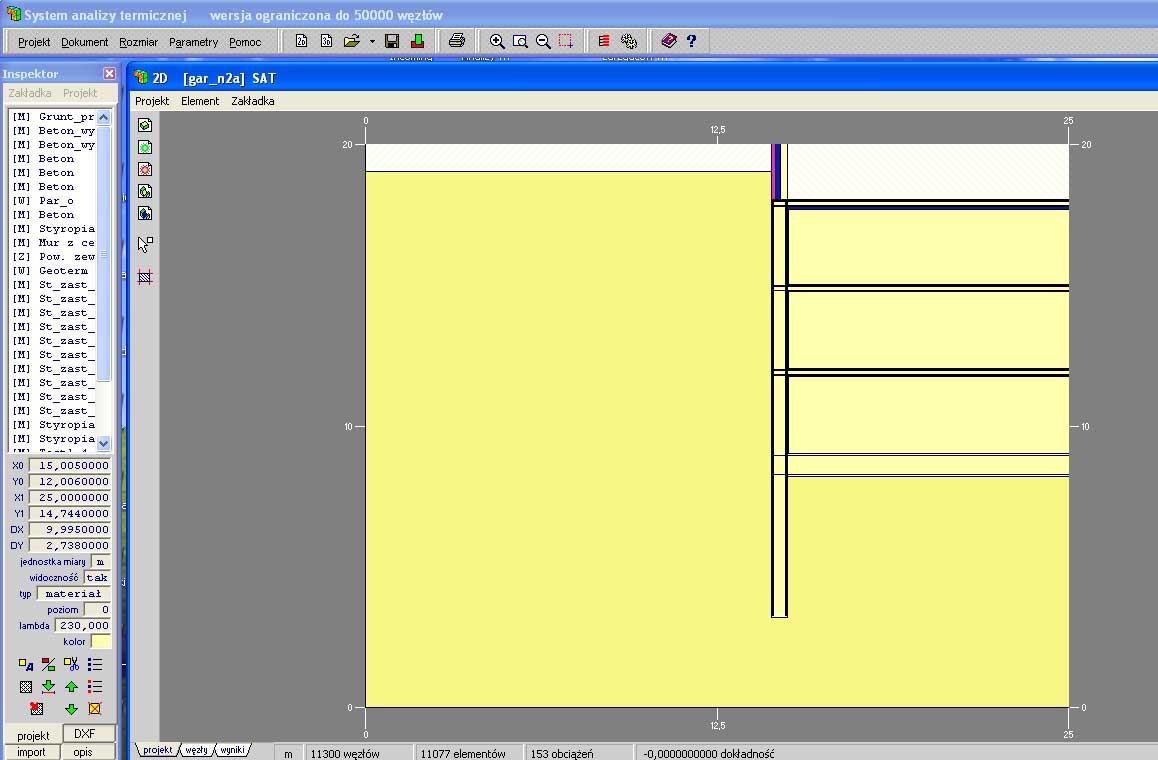
Lynx. 1. A 2D model was created in the Thermal Analysis System.
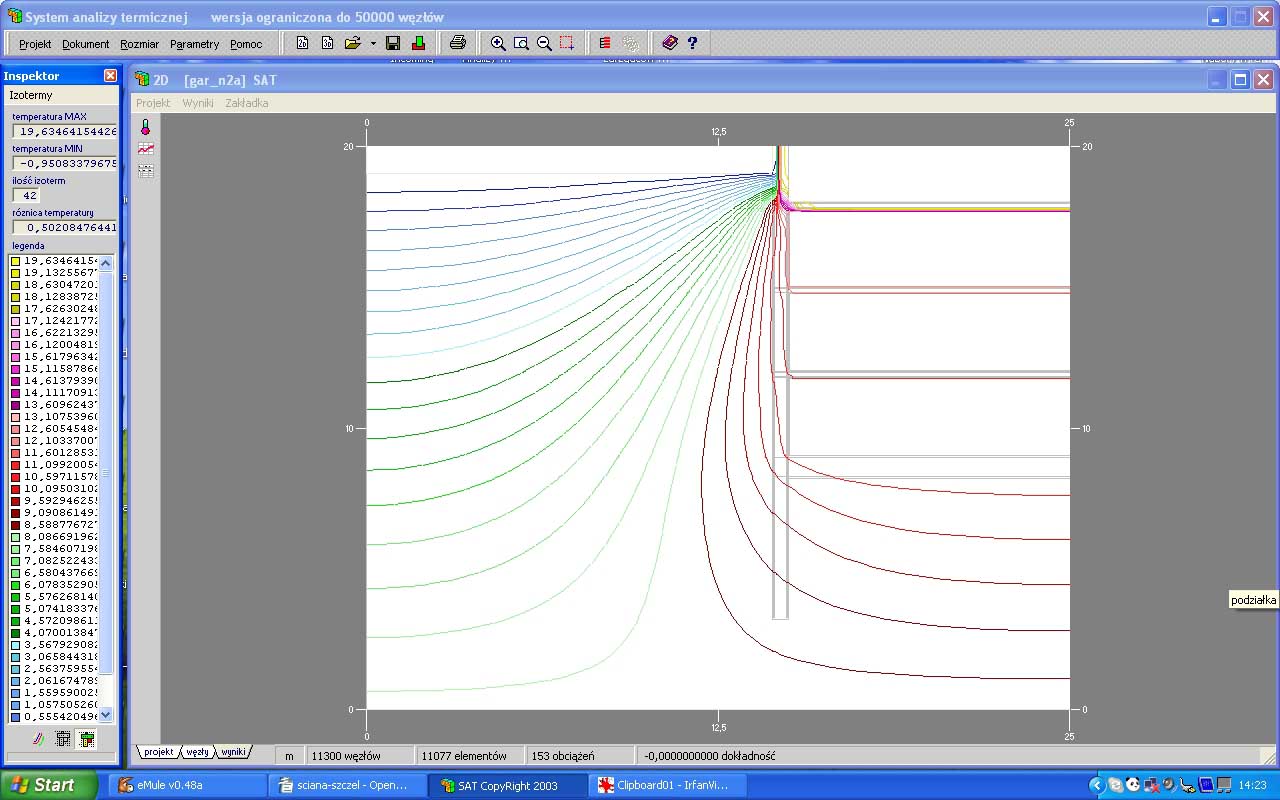
Lynx. 2. Result isotherms.
scoreboard:

U (U0) for the modeled outer wall of the ground floor it is 0,184 W/(m2K)
Value of the conventional total linear heat transfer coefficient (containing the effect of the entire diaphragm wall, garage foundation and ceilings) wyniesie w tym przypadku
ψi=47,0788/(20–1)/1 – 0,184*2 = 1,874 W/(mK)
Of course, this is the result only for this particular example, and the depression of the ground floor ceiling and the level of thermal insulation of the outer wall in the ground reduces heat loss.. Insulation of the ceiling on the ground floor is of fundamental importance (over -1). Here, 10cm of polystyrene on the underside of the ceiling.
Additionally, we get the temperature in the unheated basement rooms as a result
level -1. of 12,26 st. C do 12,37 st. C średnia +12.32 st. C.
level -2. of 11,52 st. C do 11,58 st. C średnia +11.55 st. C.
level -3. of 11,03 st. C do 11,09 st. C średnia +11.06 st. C.
We are dealing here with a certain simplification. Nie rozpatrujemy tu każdej kondygnacji osobno i mostków cieplnych z nimi związanych by wszystkie straty przez przenikanie ująć w jednym miejscu i w jednym liniowym współczynniku przenikania ciepła.
However, it should be remembered, that the result depends to the greatest extent on the insulation of the ground floor (over -1). Powyższe uproszczenie nie może być powodem zaniedbania faktycznego odzwierciedlenia budowy stropu nad -1 i jego połączenia ze ścianą szczelinową i ścianą parteru.
Please note, that such modeling of reality is based on the assumptions specified at the beginning. Thus, just to be sure, that the model corresponds to these assumptions, the results should be checked.
At the beginning, we assumed the temperature of the deep ground +8,26 st. C. The results show a difference on the surface of an artificial environment called geothermal 0,004 st. C. The difference is small enough, that it can be concluded that the model is internally consistent.
It is important to remember, that the second deep-seated building is located in the area of direct impact of the building in question (you ok. 4.5m) changes the model and the results.