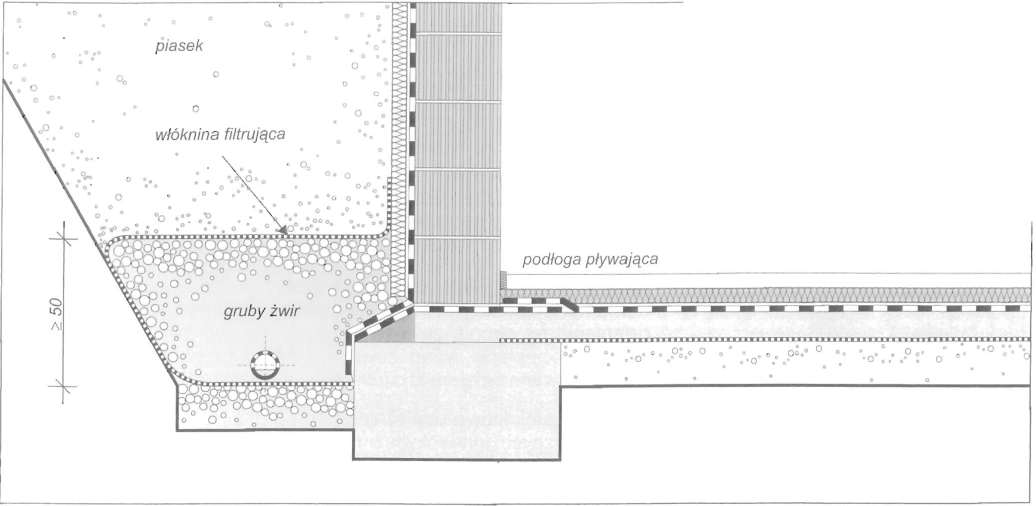
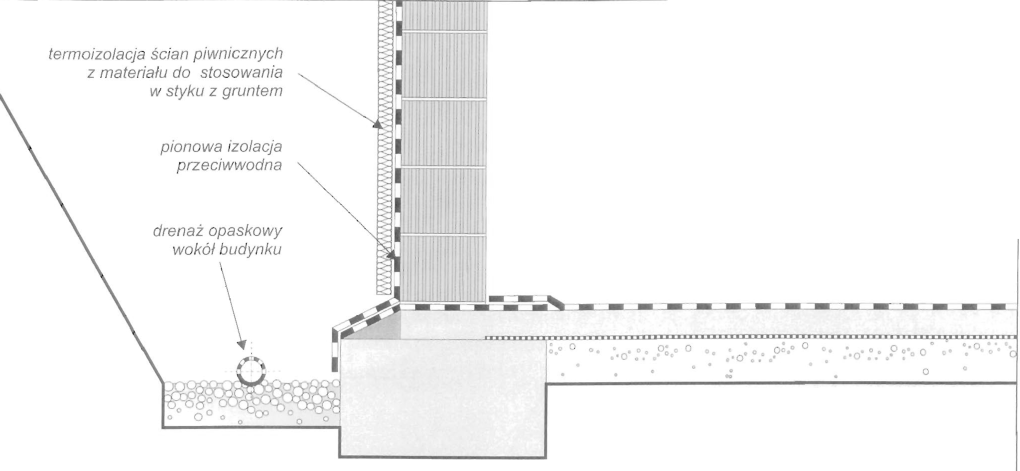
The drawings show a standard solution for foundations and insulation of the building's ground floor.
Instead of a lean concrete screed between the footings, a reinforced concrete slab based on strip footings is used, falling under the external structural walls.
The sequence of works presented in the drawings allows for the implementation of waterproofing in an extremely durable and effective way, which is very important in the more and more frequent use of basements as utility rooms. Reinforced concrete slab overlapping the foundation walls prevents shearing of waterproofing due to uneven settlement of strip footings and floor screeds. Circular drainage around the building prevents the formation of stagnant rainwater at the junction of strip foundations and basement walls.
In the basement rooms, horizontal waterproofing is installed, connecting with the insulation installed under the load-bearing walls. Vertical waterproofing is best protected against mechanical damage with a thermal insulation material for use in contact with the ground..
 A coarse gravel drainage layer is made at the bottom of the trench, filter fleece protected against fouling. Floor layers are made on the horizontal anti-water insulation – most often they are the so-called. floating floor – rock wool thermal insulation and concrete screed.